We Had Already Been Telling the Story
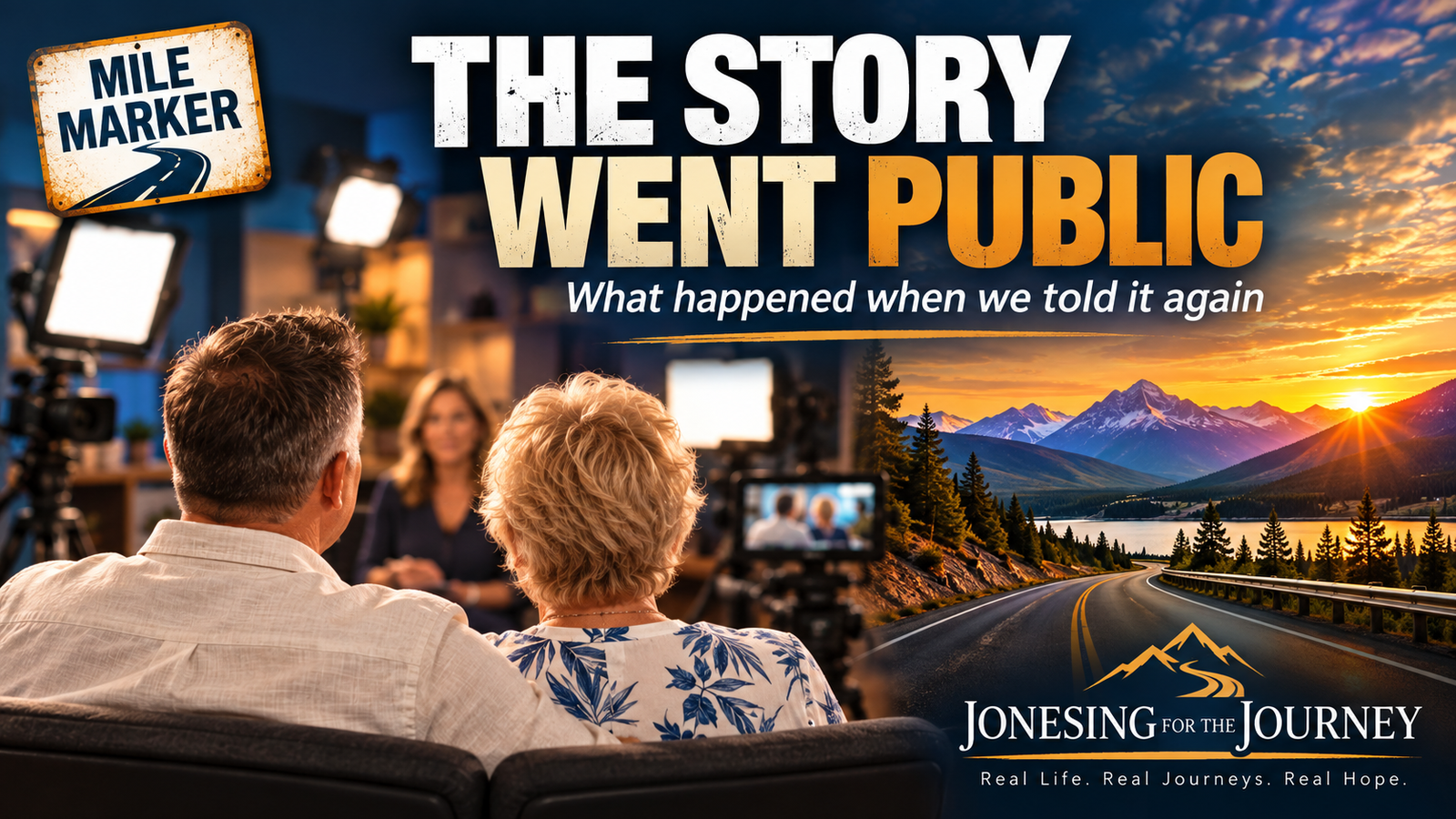
By the time Sue and I were invited to share our journey with The Patient Story, cancer was no longer something we were keeping private.
Jonesing For The Journey had already become a place where I talked openly about the diagnosis.
The decisions.
Surgery.
Recovery.
Pathology results we were not expecting.
PSA tests.
Treatment decisions.
And all of those moments when Sue and I looked at one another and wondered:
What do we do now?
So when The Patient Story asked us to sit down together and tell our story, there was an obvious question.
Why tell it again?
I thought about that quite a bit.
The answer turned out to be much bigger than simply appearing on another YouTube channel.
They Asked Us to Go Back Before Cancer
Most of the time when you’re living through cancer, the conversation begins with the disease.
What was the PSA?
What did the biopsy show?
What was the Gleason score?
What treatment did you choose?
Those things matter.
But The Patient Story asked us to go farther back.
Back to who we were before prostate cancer entered the room.
Back to the future Sue and I thought we understood.
We had been preparing for retirement.
We had a motorhome.
We imagined traveling the country.
We had a 30th-anniversary trip to Alaska planned.
We had plans.
A lot of them.
Then cancer showed up.
Before and After
Cancer has a way of dividing your life into two parts: the life you were planning and the life you suddenly have to navigate.
The Plans Didn’t Exactly Disappear
This is an important distinction.
Our dreams were not automatically erased because I was diagnosed with cancer.
But they certainly looked different.
Dates changed.
Priorities changed.
Certainty changed.
Things we thought we could schedule years into the future suddenly had medical appointments sitting in front of them.
Scans.
Blood tests.
Surgery.
Recovery.
The next treatment decision.
The journey wasn’t canceled.
It was rewritten.
That is a lesson I explored more deeply in The Journey Shifts, but sitting with another team and telling the whole story made the change much easier to see.
Why Tell the Story Again?
I kept coming back to something I had been saying almost since the beginning of Jonesing For The Journey:
If telling our story causes one person to ask one more question, then it is worth telling.
Because one more question might matter.
I felt fine before my diagnosis.
I didn’t have some dramatic symptom that announced:
You have aggressive prostate cancer.
Yet aggressive disease was there.
That remains one of the strangest parts of this experience.
You can look normal.
Feel normal.
Go to work.
Make travel plans.
Think about retirement.
And still have something happening inside your body that deserves attention.
That is one reason The Question has become such an important Mile Marker for me.
Know your numbers.
Know your history.
Participate in your own care.
And when something doesn’t make sense:
Ask one more question.
Take an Active Interest in Your Own Rescue
That phrase became increasingly important to me as the journey unfolded.
It does not mean becoming your own oncologist.
It does not mean assuming your doctors are wrong.
And it certainly does not mean replacing medical expertise with something you saw online.
It means recognizing that the patient has a role in the conversation.
Ask:
- What does this result mean?
- How does it compare with my previous results?
- Why are we comfortable waiting?
- Are there other options?
- Is another test appropriate?
- What should I be watching for?
- What am I not asking that I should understand?
Sometimes taking an active interest in your own rescue simply means refusing to remain confused when a decision matters.
They Weren’t Interested Only in My Pathology Report
One of the reasons The Patient Story felt like such a natural fit for Sue and me was that the conversation went beyond the clinical details.
Yes, we talked about prostate cancer.
But they also wanted to understand:
What happened to our plans?
What happened inside our marriage?
What was Sue experiencing while so much of the attention was focused on me?
What happens when a future you thought was predictable suddenly isn’t?
Those are cancer questions too.
One Thing Cancer Taught Us
Cancer happens in a patient’s body. The journey happens to an entire family.
Sue’s Story Belonged in the Story Too
If the interview had focused only on me, it would have been incomplete.
Sue was living this too.
She had fears I couldn’t see.
Questions she couldn’t answer.
Responsibilities she hadn’t expected.
And a future that had changed just as suddenly as mine.
The caregiver can become almost invisible once cancer enters a family.
Everyone wants to know:
How is the patient doing?
Fewer people stop and ask the person beside the patient:
How are you doing?
Sue’s perspective became such an important part of JFTJ that it eventually deserved its own Mile Marker: The Co-Pilot.
Watching Someone Else Tell Your Story Is Strange
There was another part of this experience I had not expected.
It is strange to watch someone else organize your life into a story.
When you are living through cancer, you do not experience it like a documentary.
There is no narrator telling you where you are in the story.
You experience it one moment at a time.
One appointment.
One phone call.
One blood test.
One scan.
One decision.
One difficult night.
Then another morning.
You are too busy trying to get through the chapter you’re currently living to understand what the whole book looks like.
Then Someone Put All the Chapters Together
Suddenly, Sue and I were looking at our own lives from the outside.
There were moments that were difficult for me to watch.
Other moments made me smile.
And some reminded me just how much had changed in a very short period of time.
That perspective gave me something cancer rarely gives you while you’re in the middle of it:
distance.
Not emotional distance from what happened.
Enough distance to see that individual appointments and results had begun forming a larger story.
The Story Wasn’t Really About Cancer Alone
Cancer was obviously at the center of the interview.
But watching it back reinforced something I had gradually been realizing about Jonesing For The Journey.
The story wasn’t simply:
Mike got prostate cancer.
It was also:
What happens when life does not follow the plan?
What happens when the person who normally feels strong suddenly needs help?
What happens to marriage when both people are scared?
What happens to the future when certainty disappears?
And perhaps most importantly:
How do you continue living while the answers are still unfolding?
I Started Understanding What JFTJ Was Becoming
When Sue and I first imagined Jonesing For The Journey, this wasn’t the journey we thought we would be documenting.
We pictured retirement.
Travel.
A big motorhome.
Open roads.
New places.
Adventures after years of working and planning.
Then cancer changed the road.
But somewhere along the way I realized:
The journey didn’t disappear because the destination changed.
In many ways, that realization became The Purpose behind what JFTJ was becoming.
Cancer Can Put Life on Hold Without Asking Permission
There is a trap I have noticed in myself.
I’ll relax after the next test.
We’ll make plans after the next scan.
I’ll feel better once I know the PSA.
We’ll get back to normal after treatment.
I’ll start living again once I know everything is okay.
Except cancer does not always give you a clean moment when someone walks into the room and announces:
Everything is okay now. You may resume your life.
There may always be another test.
Another appointment.
Another number.
Another question.
What If “Okay” Never Comes in the Form I Am Waiting For?
That question changed something for me.
Because if I wait for complete certainty before allowing myself to live, I could spend an awful lot of whatever time I have waiting.
And that isn’t the life I want.
It does not mean ignoring cancer.
I will keep going to appointments.
I will keep watching the numbers.
I will keep making treatment decisions.
I will keep asking questions.
But I also want to notice the life occurring between those appointments.
A Different Kind of Question
Maybe the question isn’t, “When will life go back to normal?” Maybe it is, “How do I keep living while life is different?”
Maybe We Don’t Need to Know Exactly Where the Road Ends
This is something I am still learning.
I don’t know exactly where this cancer journey ends.
I don’t know every treatment decision that may still be ahead.
I don’t know how every plan Sue and I have will turn out.
But perhaps our job isn’t to know every mile before we begin traveling.
Maybe our job is simply to make sure we don’t miss the life happening now because we are staring too far down the road.
Going Public Changed the Purpose of the Story
When a personal story leaves your own circle, something changes.
It stops belonging only to you.
A man you have never met may recognize his own PSA story in yours.
A wife may recognize herself in Sue.
Someone newly diagnosed may hear a question they had not thought to ask.
Someone who has been postponing an appointment may finally schedule it.
Someone waiting for a test result may realize they are not the only person struggling with uncertainty.
That is where storytelling becomes something more than documentation.
It becomes connection.
And sometimes connection becomes action.
That is part of what I mean when I talk about Paying Hope Forward.
Sharing Your Story Comes With a Responsibility
There is something else I have become increasingly aware of.
My experience is not everybody’s experience.
My diagnosis does not predict someone else’s.
My surgery outcome does not predict theirs.
My treatment decisions are not instructions for another patient.
Telling a patient story responsibly means being honest about that.
I can tell you what happened to me.
I can tell you what I wish I had known.
I can tell you what I asked.
I can tell you what I would ask differently today.
But the goal is not to make your decision for you.
The goal is to help you arrive at your own healthcare conversation better prepared.
What I Hope You Take From This Mile Marker
You do not have to tell your story publicly.
Some stories should remain private.
Some are shared only with family.
Some with a support group.
Some with one person who needs to hear them.
What matters is not the size of the audience.
What matters is whether something you learned can help another person travel their next mile better prepared.
For Sue and me, saying yes to The Patient Story gave our experience a much larger audience.
But it also gave us something unexpected.
It allowed us to step outside our own journey for a moment and see what the journey had become.
Not simply a cancer story.
A story about marriage.
Caregiving.
Plans changing.
Questions.
Fear.
Advocacy.
Hope.
And learning to keep living while the answers are still unfolding.
Roadside Reflection
You may not see the story while you’re busy surviving the chapter.
Watch the Story
Sue and I shared the larger story together with The Patient Story, including the PSA changes, diagnosis, surgery, recovery, treatment decisions, and caregiver perspective.
My AGGRESSIVE CANCER Was HIDING Behind a “Normal” Blood Test!
Watch our feature on The Patient Story
I also recorded my reflections afterward about why Sue and I chose to tell the story again and what the experience taught me.
What I Learned After Sharing My Cancer Story With The World
Watch on Jonesing For The Journey
Continue the Journey
What to Read Next
The Purpose
Read how sharing our own experience gradually became a mission to help
patients and caregivers ask better questions.
The Co-Pilot
Hear the journey from Sue’s side and why the caregiver’s story deserves
to be seen alongside the patient’s.
Paying Hope Forward
See how the lessons we received along the road became something we wanted
to pass along to the people traveling behind us.
And So…The Adventure Continues.