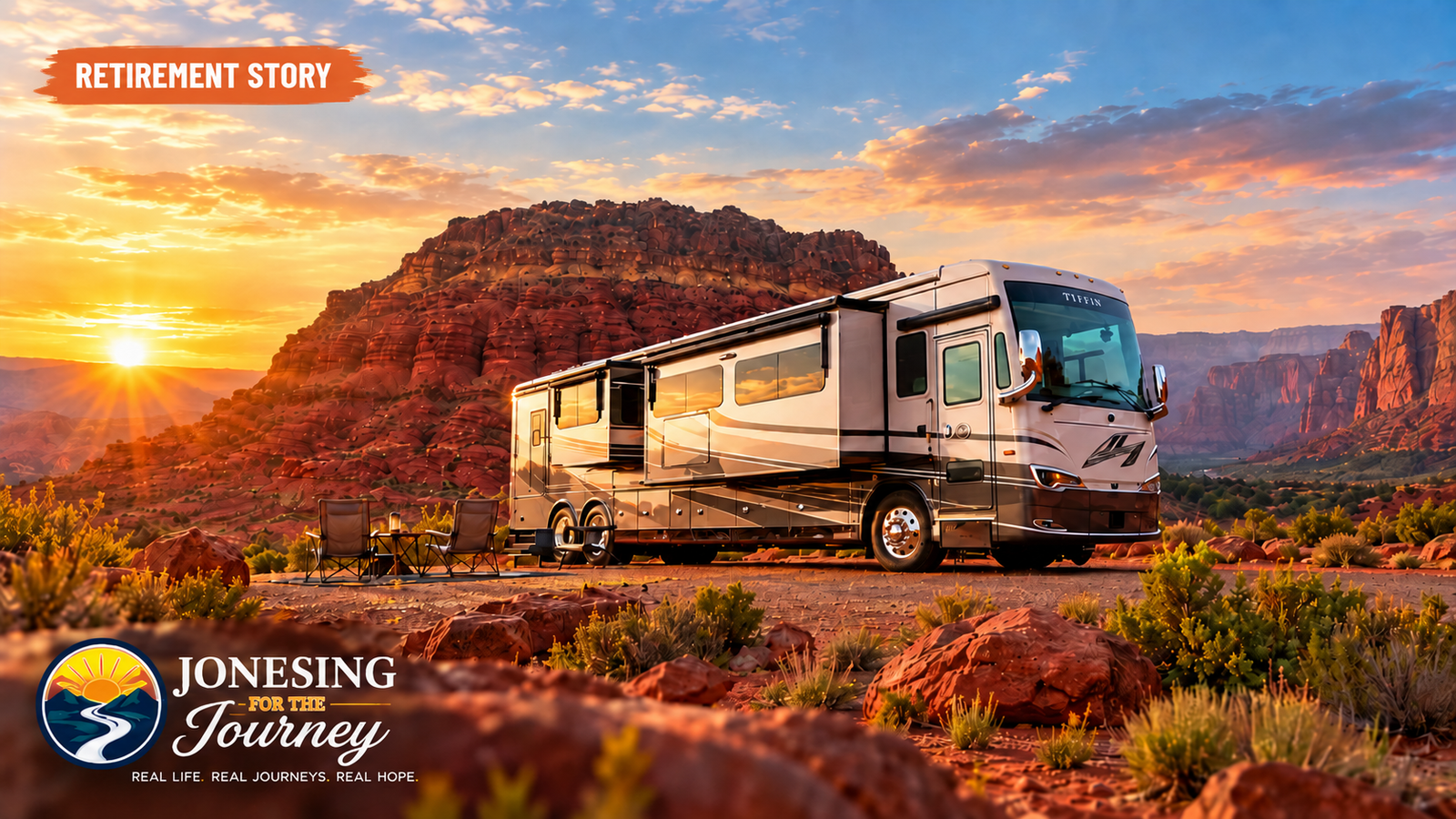
Sell everything. See the country. Chase 70 degrees. That was the retirement plan—and it still is.
This Wasn’t Going to Be Our RV. It Was Going to Be Our Home.
When Sue and I started planning retirement, we weren’t talking about buying an RV for weekends, vacations, or a few trips every summer.
The plan was much bigger than that.
We were going to sell everything.
The house.
Most of what we had accumulated over decades.
The things sitting in closets, cabinets, garages, and boxes that somehow keep following you from one house to another.
We were going to simplify our lives, move into a motorhome, and make the road our home.
Not for six weeks.
Not for one summer.
Full-time.
We wanted to travel the country on our terms, stay longer in the places we loved, move when we were ready, and finally experience parts of America Sue and I had spent much of our lives saying we would see someday.
And we had a very simple idea for deciding where to go next:
Chase 70 degrees.
Head south when winter arrived.
Move north when summer became too hot.
Follow spring and fall whenever possible.
No snow if we could help it.
No brutal summer heat if we could avoid that too.
Just keep moving through the country in search of comfortable weather, beautiful places, and the freedom we had spent decades working toward.
The Retirement Plan
Sell everything. Live full-time in the motorhome. See the country. Chase 70 degrees.
The Dream Started With Seeing More of the Country
Part of this dream started because of my job.
Work gave me opportunities to travel to parts of the country I had never really experienced before.
And the more I saw, the more I realized how much of this country Sue and I had never seen together.
I would come home and talk about the places I had visited, the landscapes, the roads, the parts of the country that looked completely different from what we were used to in the Midwest.
Eventually the question became obvious:
Why don’t we go see all of this together?
Not while trying to squeeze everything into a seven-day vacation.
Not while watching the clock because we needed to get back to work.
We wanted enough time to actually experience a place.
Stay another week if we liked it.
Change the route if something interesting appeared along the way.
Wake up and decide that maybe we weren’t ready to leave yet.
That kind of freedom became the real dream.
We Wanted to Travel on Our Terms
That phrase became important to both of us.
Go when we wanted.
Go where we wanted.
And, most importantly, go how we wanted.
We imagined large western loops across the United States.
Yellowstone.
The Grand Canyon.
The Sierra Nevadas.
The Pacific Northwest.
Alaska.
The Northeast.
The beautiful places throughout the Midwest that we had lived near for years but never really taken the time to explore.
The Southeast.
Coastal areas.
Small towns.
National parks.
And roads we hadn’t even discovered yet.
Chasing 70 Degrees
Somewhere during all of the planning, I started calling our travel strategy:
Chasing 70 degrees.
It’s not complicated.
If it gets cold, move south.
If it gets too hot, head north or find elevation.
Try to spend as much of the year as possible somewhere the windows can be open and the weather makes you want to be outside.
We weren’t trying to outrun every uncomfortable day.
But if your home has wheels, one of the great advantages is being able to choose the season you’re living in.
At least most of the time.
Our Travel Philosophy
Home comes with us. The destination can change. And whenever possible, we chase 70 degrees.
Once You Decide to Sell Everything, 45 Feet Makes More Sense
When someone hears “45-foot motorhome,” I understand why the first reaction might be:
Why do two people need something that big?
But that’s looking at it as a vacation vehicle.
We weren’t.
We were planning to sell our traditional home.
The motorhome would become the home.
If you’re spending a weekend at a campground, you can tolerate compromises that become much more significant when you’re living in the RV every day.
We weren’t asking:
What can we camp in?
We were asking:
What could we comfortably live in?
That’s a very different question.
The Tiffin Allegro Bus 45 OPP Became the Coach We Planned Around
The motorhome Sue and I kept coming back to was the Tiffin Allegro Bus 45 OPP.
We had not purchased it yet.
But it became the coach around which we built much of the retirement plan.
What attracted us wasn’t simply that it was large.
It was that the space and features made it feel much more like a home than a temporary place to stay.
The layout we were looking at offered things that become meaningful when the motorhome is your primary residence:
- A bath-and-a-half floor plan
- A king-size bed
- Theater-style seating
- A fireplace and large television
- A washer and dryer
- A dishwasher
- Substantial storage for extended and full-time travel
- Room for Sue, me, and our dog to live comfortably
No one needs those things to go camping.
But we weren’t planning to go camping.
We were planning to live there.
It Needed to Feel Like Home
That was the real test.
Could we wake up there every day?
Could we cook there?
Do laundry there?
Relax there?
Work there when needed?
Spend a rainy day inside without feeling like the walls were closing in?
Could Sue and I each have enough personal space that full-time RV living didn’t mean spending twenty-four hours a day sitting three feet apart?
That’s why the size mattered.
This wasn’t supposed to feel like camping for the rest of our lives.
It was supposed to feel like home—with a constantly changing backyard.
The Goal Wasn’t to Escape Home
It was to stop needing one permanent address to define where home was.
That’s probably the best way I can explain what attracted us to full-time RV living.
We weren’t running away from anything.
We were trying to create freedom.
If we loved a place, stay another week.
If the weather turned, move.
If we wanted to spend a month exploring Utah, do it.
If we found somewhere unexpected that we loved, change the plan.
The route could change.
Home would come with us.
The Dream Had a Budget
Anyone who knows me probably won’t be surprised by this.
I didn’t just dream about full-time RV life.
I built a budget for it.
Dreaming about living on the road is easy.
Understanding whether you can realistically afford to do it is a completely different exercise.
I looked at campground costs.
Fuel.
Maintenance.
Insurance.
Storage.
The cost of moving a 45-foot diesel motorhome around the country.
The cost difference between expensive resort-style campgrounds and places where we could stay much more affordably.
We thought about a seasonal home base.
We thought about what our monthly retirement expenses might actually look like.
The dream was emotional.
The planning was practical.
Then Came the Campground Map
This may have been one of my favorite pieces of planning.
I created a campground map in Google.
It wasn’t simply a map with places we thought looked pretty.
I was identifying places around the country that could accommodate a rig the size we were considering.
Some were traditional RV parks.
Some were higher-end destinations.
Some represented much less expensive options.
And some were opportunities to stay overnight for little or no cost.
Many of the locations were connected to videos from RVers who had actually stayed there.
I wanted to know what arriving there really looked like.
Could a large coach make the turn?
How difficult was access?
What were the sites actually like?
Would we fit?
A campground website can tell you one thing.
Watching somebody actually drive a large rig into the property tells you something else.
A 45-Foot Motorhome Changes the Way You Travel
We understood there would be tradeoffs.
A coach that size gives you a lot of living space.
It also means you need to think ahead.
Not every campground works.
Not every site works.
Not every road is one you want to take.
Length matters.
Height matters.
Turning radius matters.
Access matters.
That’s why planning became part of the fun for me.
The goal wasn’t to eliminate uncertainty.
It was to know enough to make good decisions.
Florida Was Part of the Full-Time Plan
We also talked about establishing some type of RV home base in Florida during the winter months.
The idea was to have a place we could return to regularly.
Somewhere warm.
Somewhere that could serve as an anchor.
Somewhere to handle the ordinary parts of life that don’t disappear simply because your home has wheels.
Then, when the season changed, we could head back out.
North.
West.
Wherever the road and weather took us.
Again:
Chase 70 degrees.
Selling Everything Meant Learning to Need Less
The physical part of this plan started long before buying the RV.
We began looking at everything we had accumulated over decades.
And there was a lot of it.
Boxes.
Old photographs.
Things in the attic.
Things we hadn’t used in years.
Things we had forgotten we owned.
We started downsizing.
We digitized photographs.
We began getting rid of things that no longer served a purpose.
Because if you’re really planning to sell everything and live in a motorhome, you eventually have to decide what deserves to come with you.
And perhaps more importantly:
What doesn’t?
The More We Planned, the More the Dream Became Real
That’s what made the original retirement plan different from a vague someday dream.
We were already doing the work.
Budgeting.
Mapping.
Downsizing.
Researching.
Thinking about mail.
Thinking about medical care.
Thinking about insurance.
Thinking about storage.
Thinking about what happens when you no longer have a traditional home waiting for you somewhere.
We weren’t simply saying:
Wouldn’t it be fun to travel in an RV?
We were preparing to change the way we lived.
The Motorhome Was Really About Freedom
When you strip away the brand name, the diesel engine, the floor plan, and all of the features, the reason we wanted this life was surprisingly simple.
Freedom.
Freedom to control our time.
Freedom to stay longer somewhere we loved.
Freedom to change the route.
Freedom to see more of the country than we ever could while fitting travel around jobs and limited vacation time.
Freedom to bring our own space with us.
Freedom to wake up knowing there was another road available whenever we were ready to take it.
The motorhome was the vehicle. The real dream was control over our time.
Then the Schedule Changed
Anyone who has followed Jonesing For The Journey knows what happened next.
Cancer arrived before the motorhome did.
Suddenly there were different things on the calendar.
Biopsies.
Surgery.
Recovery.
Treatment.
Monitoring.
Medical appointments that don’t particularly care where your campground map says you’re supposed to be.
The original timeline changed.
That part of the story is something I explore more fully in The Road We Still Plan to Take .
But there is one distinction I want to make very clearly here.
The Plan Is Delayed. It Is Not Past Tense.
It would be easy for me to describe all of this as the retirement plan Sue and I used to have.
That’s not accurate.
We still have it.
We still want to sell everything.
We still want the motorhome.
We still want to live on the road full-time.
We still want to travel across the country.
We still want Alaska.
We still want the national parks.
We still want the open roads.
And I still intend to spend an unreasonable amount of time trying to keep us somewhere around 70 degrees.
What changed was the schedule.
Still the Plan
Sell everything. See the country. Chase 70 degrees. The timeline changed. The dream didn’t.
Cancer Has to Be Part of the Planning Now
That’s the reality.
Treatment matters.
Monitoring matters.
Medical appointments matter.
Staying connected to my healthcare team matters.
How I feel matters.
Maybe the transition to full-time travel happens differently than we originally imagined.
Maybe there are periods when we need a stronger home base.
Maybe trips get interrupted.
Maybe the route occasionally needs to point toward a medical appointment instead of a national park.
We’ll figure that out when we get there.
What I don’t want to do is talk about this dream as though it died when I was diagnosed.
It didn’t.
The Maps Are Still There
The campground map is still there.
The budget is still there.
The research is still there.
The motorhome dream is still there.
Yellowstone is still there.
The Grand Canyon is still there.
The Pacific Northwest is still there.
Alaska is still there.
And there is an entire country full of places Sue and I still haven’t experienced together.
What changed was when.
Not why.
Would We Still Choose the Same 45-Foot Motorhome?
That’s one question we’ll revisit when we’re actually ready to buy.
Life has changed since we first built the plan.
Our needs may change.
The way we expect to travel may change.
Technology will change.
RV models will change.
And we’re not going to buy something simply because it was the answer we chose several years earlier.
When the time comes, we’ll look at everything again.
But the reasons we were attracted to a 45-foot Class A diesel pusher still make sense.
- Enough room for true full-time living
- A comfortable bedroom
- Residential-style conveniences
- Washer and dryer capability
- Significant storage
- Room for us and our dog
- Living space that could actually feel like home
The specific motorhome may eventually change.
The kind of life we’re trying to create has not.
What I Would Tell Someone Considering Full-Time RV Retirement
Don’t begin with the RV.
Begin with the life.
Ask yourself:
- Do you really want to travel full-time, or would extended trips fit you better?
- How much personal space do you need?
- Where do you actually want to travel?
- How often do you expect to move?
- What weather are you trying to follow—or avoid?
- What does your budget realistically support?
- How much stuff are you willing to give up?
- What conveniences will matter after six months, not just six days?
- Do you need a permanent or seasonal home base?
- What will medical care, insurance, mail, and other everyday needs look like?
Then start looking at RVs.
Because the right RV isn’t necessarily the biggest one.
It’s the one that supports the life you’re trying to live.
Roadside Reflection
Don’t choose the RV first. Choose the life you want the RV to make possible.
This Is Where Jonesing For The Journey Actually Started
Long before this became a place where I talked about prostate cancer, Jonesing For The Journey had another purpose.
This was supposed to be the story.
Retirement.
Selling everything.
Moving into the motorhome.
Traveling the country.
Learning how to live full-time on the road.
Sharing the places we discovered.
Sharing what worked.
Sharing what didn’t.
And probably talking far too much about the temperature.
Then life handed us another journey first.
The cancer journey became part of Jonesing For The Journey because it became part of our life.
But it didn’t replace what we originally set out to do.
In many ways, it made getting there matter even more.
Watch the Original RV Story
I originally shared the story behind our retirement dream—the 45-foot motorhome, the full-time plan, the campground map, the budget, downsizing, and the idea of traveling the country while chasing 70 degrees.
We Planned to Retire in This Motorhome | Then Cancer Changed Everything
Watch on YouTube
Continue the Journey
What to Read Next
The Road We Still Plan to Take
The original retirement timeline changed, but Sue and I still intend
to make the RV dream part of our future.
The Trip We Didn’t Take
Our 30th-anniversary Alaska trip didn’t happen on schedule—but Alaska
is still very much on our horizon.
The Journey Shifts
What happens when the future you’ve spent years planning suddenly
needs a different route.
And So…The Adventure Continues.